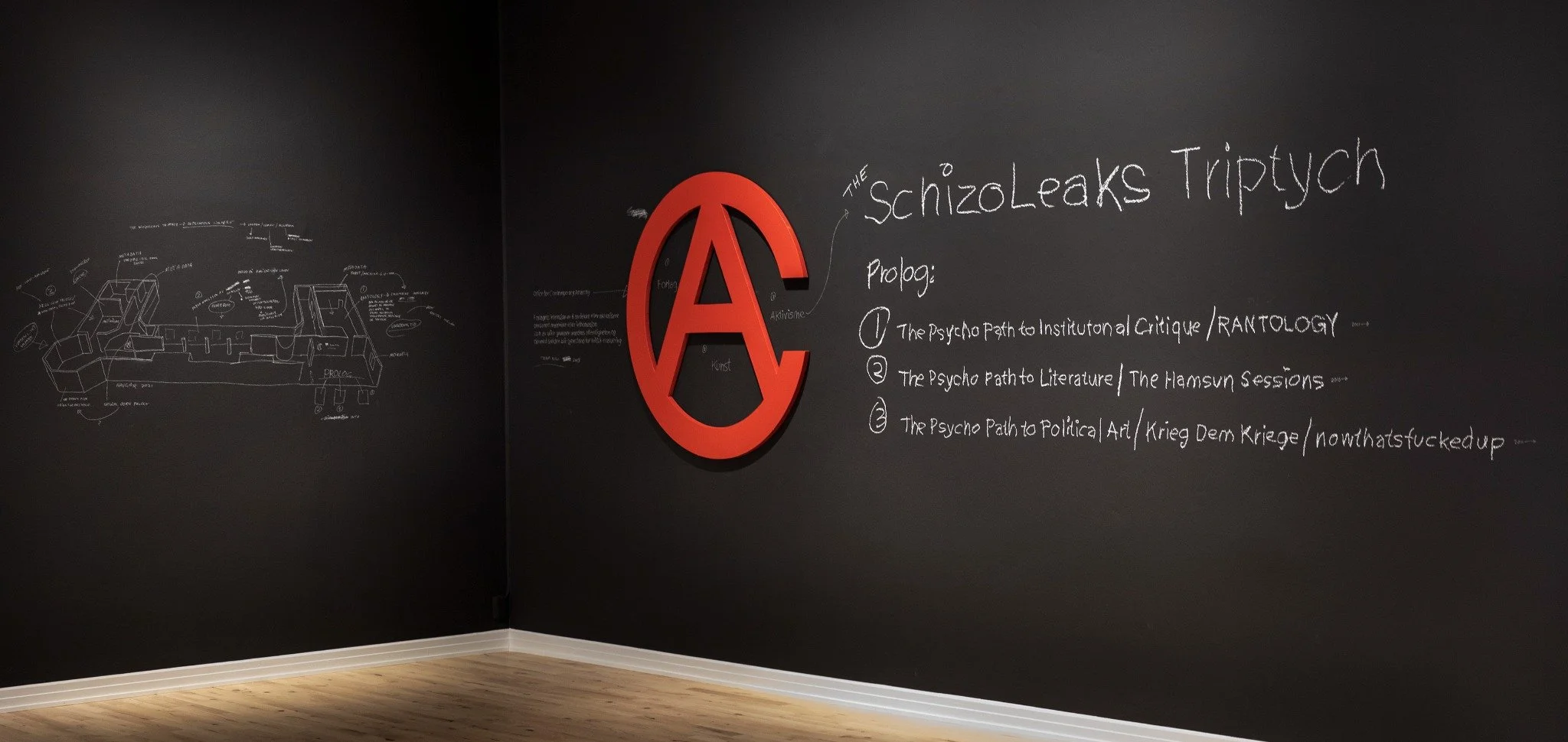
SchizoLeaks
Information wants to be art
SchizoLeaks turns the leak into an artistic method. Across three independent projects, Thomas Kvam republishes material that tests the limits of patient confidentiality, press ethics and the public representation of violence. Publication becomes an intervention in who has the authority to decide what can be seen, read and known.
Adapting the logic of WikiLeaks to art, Kvam works with a vanished archive of soldiers’ war photographs, the writings left by the Columbine killers, and the psychoanalytic records of Nobel laureate and Nazi supporter Knut Hamsun. The barriers differ: legal protection, editorial restraint, encoded handwriting and documents buried within an overwhelming mass of information. Books, paintings and installations give the material a new public life, testing the restrictions and conventions that govern its circulation.
Nowthatsfuckedup / Krieg dem Kriege
American soldiers traded photographs from Iraq and Afghanistan for access to pornography. Kvam preserved part of the website and published the images with their accompanying comments as an anti-war book. The dead had become currency; their republication confronts the public with the distance between humanitarian rhetoric and the conduct of war. In The Chosen Five, the project moves from exposure to pursuit: facial-recognition searches attempt to identify five soldiers photographed posing over a burnt corpse. Surveillance is turned towards those who usually operate behind it.
Rantology
From tens of thousands of pages of Columbine investigation files, Kvam extracts Eric Harris and Dylan Klebold’s literary writings and drawings, publishing their poetry and prose and translating their graphic marks into paintings. Documents examined for evidence and symptoms are reopened as acts of writing and self-invention. The shift challenges the authority of diagnosis and the media’s manufacture of perpetrators as cultural figures, while implicating the publisher in giving the killers the posthumous audience they imagined.
The Hamsun Sessions
Six years after receiving the Nobel Prize in Literature, Hamsun sought treatment for writer’s block from Johannes Irgens Strømme. The psychoanalyst recorded their sessions in his personal variant of Gabelsberger shorthand. Kvam reproduces these protected patient records in paintings and publishes transcribed pages without permission. The work brings patient privacy into conflict with public scrutiny of a literary genius and Nazi supporter, making the artist’s breach of confidentiality part of the work itself.
The leak offers no innocent position. Publishing can expose violence and repeat a humiliation; a document can become evidence, literature, a painting or a commodity. Once the material enters the museum, the institution’s own authority and the artist’s claim to freedom are at stake. SchizoLeaks turns its investigation back on the means of disclosure: what is revealed, who gains from the revelation, and what remains concealed by the form in which it is shown.
Exhibition
SchizoLeaks — Haugar Kunstmuseum, 2021
The three projects were presented together as a triptych for the first and only time at Haugar, 25 September–30 December 2021. Each has an extensive exhibition and publication history of its own.
Publication
SchizoLeaks: Information wants to be art
H//O//F and Thomas Kvam, 2021 · 112 pages · Norwegian
With a foreword by Thomas Kvam, an interview with Evelyn Holm, and a remix of curatorial working notes by Tone Kathrine Lyngstad Nyaas.